

Every fantasy football draft comes down to the same uncomfortable moment. The clock is running, three names are sitting on your board, and you have about forty seconds to decide which one actually makes your team better. Most tools hand you a ranking and wish you luck. Draft Engine hands you the math.
Draft Engine is a probability driven draft companion built for people who want to know what a pick is worth, not just where it sits on a list. It runs live during your draft, it adapts to every player who comes off the board, and it works in both snake and auction formats.
Built on Distributions, Not Rankings
A ranking tells you one number. Draft Engine gives you the whole shape of a player’s season.
Every player in the database carries a full projection profile: a median outcome at P50, a strong outcome at P75, and a ceiling outcome at P90. Alongside those, the engine tracks the probability that a player clears meaningful season totals such as 200, 250, 300, and 350 fantasy points. It also carries finish odds, meaning the chance a player ends the year as the overall number one at his position, or inside the top three, top five, or top twelve.
Those numbers are anchored to real market inputs. Rushing yardage lines, receiving yardage lines, reception totals, and touchdown lines all feed into the projection layer, with player tiers derived from live season long odds ranges. The result is a board that reflects what the market actually believes, not what a magazine printed in June.
Sort by any column. Search by player, team, or tier. Mark the players you own, mark the ones who are gone, and hide the noise so you only see what is still live.
The Simulation Engine Is the Star
This is where Draft Engine stops being a cheat sheet and starts being a decision tool.
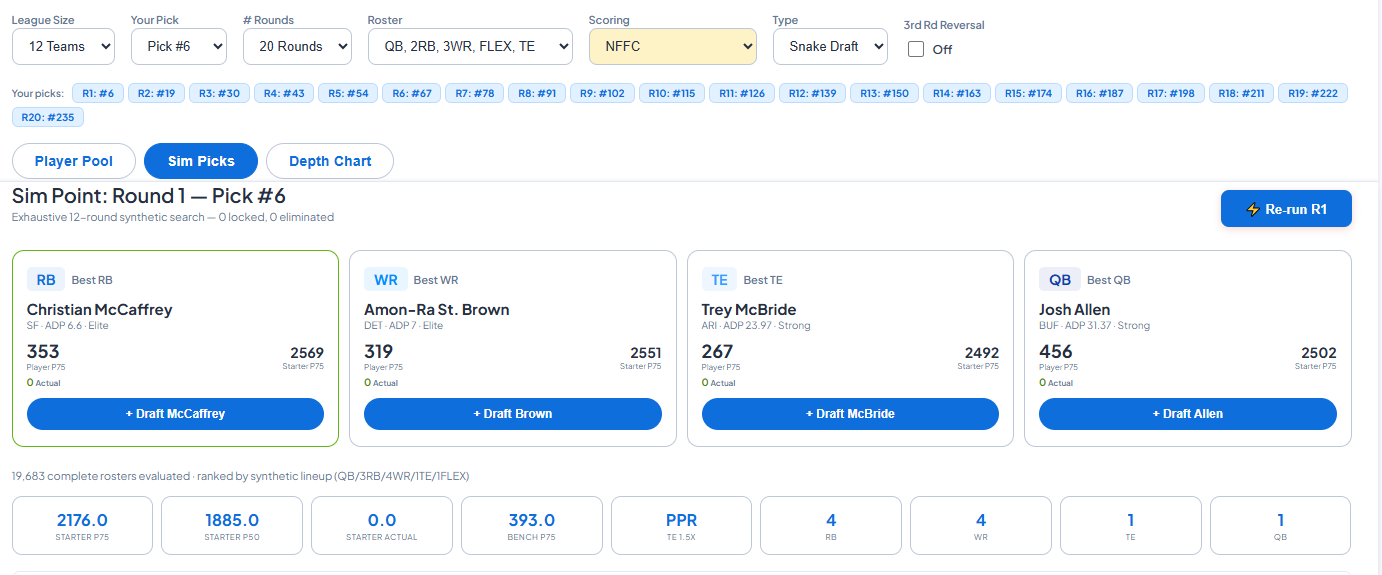
At any point in your draft, you can set a sim point at your current round and pick, then run the simulation. The engine performs an exhaustive synthetic search across your remaining rounds, filling out complete rosters given who is realistically available at each of your future selections.
It does not run this once. It runs four separate position strategies in parallel, testing what happens if you take the best available wide receiver, the best running back, the best tight end, or the best quarterback right now, and then plays each of those branches all the way to the end of your draft. Alongside those four, it surfaces the best overall roster it can construct.
Each finished roster is scored on the metrics that matter: projected starting lineup strength at P75, bench strength at P75, and the total team outlook. You are no longer choosing between two players. You are choosing between two finished teams.
Every simulated roster comes with two views. The projected starting lineup shows you exactly who slots in where. The team probability analysis breaks your roster into position groups and shows the odds your quarterbacks, running backs, receivers, tight ends, and flex pool clear the thresholds that decide leagues.
When a run finishes, the engine also builds a backup board covering your remaining rounds and your bench targets, so you know your fallback plan before you need it.
Snake Drafts, Configured Your Way
Draft Engine adapts to your league instead of forcing you into a default.
Set your league size, your number of rounds, and your draft slot. Flip on third round reversal if your league uses it, and the engine recalculates every future pick you own. Choose your roster construction, whether that is a standard build with a single flex or a double flex configuration. Pick your scoring format across PPR, FFPC with the tight end premium, or NFFC settings.
From there the board goes live. Every pick you log and every player you mark as gone reshapes what the simulation considers available. You can also apply structural constraints, such as holding off on a quarterback until the later rounds, and watch how that decision ripples through your projected roster before you commit to it.
Auction Mode That Actually Solves the Budget
Auction leagues break most draft tools, because the question is never simply who is best. The question is what combination of players your remaining dollars can buy.
Draft Engine treats that as the optimization problem it is. The auction module runs a knapsack optimizer across your budget to find the highest starting lineup P75 you can still reach. It holds kicker and defense at a dollar so your capital goes toward skill positions, and it reports your remaining budget, your open roster slots, and your true maximum bid at all times.
Log a winning bid and the engine prompts you for the price paid, then instantly recalculates what is still affordable. Try to overspend and it tells you before you regret it.
Two features make auction rooms much calmer. Roster floor controls let you require two or three strong running backs in any solution, so the optimizer respects your structural preference. And the build around feature lets you search any player, lock him in, and see every optimal roster that can be built with him, ranked by resulting team P75. Want to know whether you can actually afford the anchor back you love? Now you know before the bidding starts.
Your Data, Your Projections
Draft Engine ships with a complete projection set ready to go, and every projection carries a timestamp so you always know how fresh your numbers are.
If you run your own models, the projection admin panel accepts a CSV upload or syncs from your own projection API endpoint. Rerun projections on demand, clear saved data whenever you want a clean slate, and everything persists locally between sessions so your draft survives a refresh.
Draft With Conviction
The best drafters are not the ones with the best rankings. They are the ones who understand what each choice does to the shape of their season. Draft Engine puts that understanding on your screen, one pick at a time, in whatever format your league plays.
Load your league settings. Run the simulation. Take the pick you can actually defend.