

Everybody drafts the first ten rounds well. The names are obvious, the rankings agree with each other, and the market has already done most of the thinking for you. Nobody wins a championship in round three.
Leagues get decided in rounds 11 through 20. That is where the backup who inherits a starting job in week five lives. That is where the receiver who is one injury away from twelve targets a game is sitting, unowned, while your league mates draft their fourth quarterback.
And that is exactly where almost every draft tool goes dark. Rankings flatten out. Projected points for a player buried on a depth chart round down to nothing by design, because his projection assumes he never plays. So the board tells you these guys are all worthless, which is true right up until the moment it is spectacularly false.
Draft Engine handles the late rounds with a dedicated tool built on a completely different question.
The Backup Board
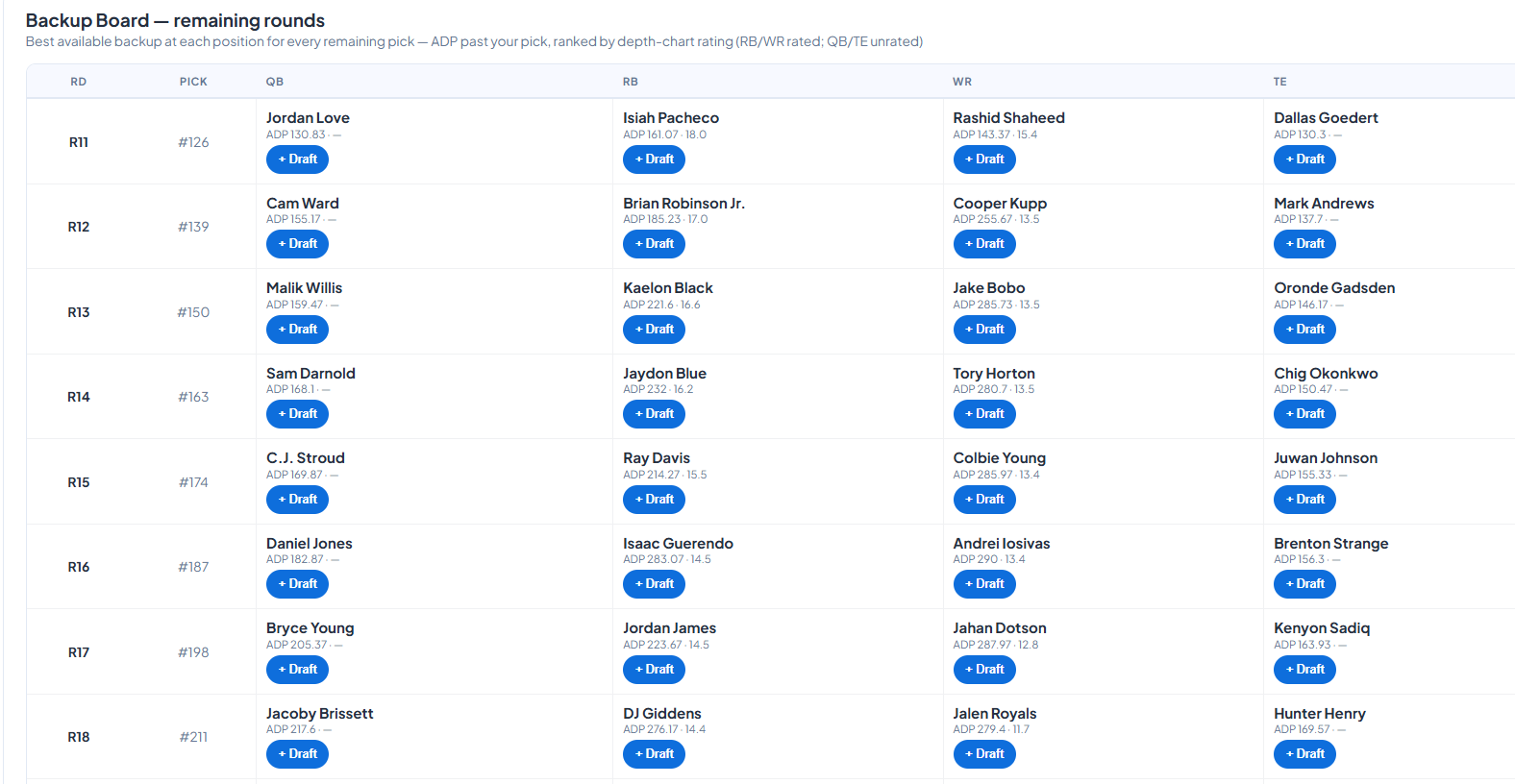
Once your draft moves past the early rounds, Draft Engine builds a Backup Board covering every remaining pick you own, out to round 20.
It is a grid. Every row is one of your actual future picks, labeled with the round and the real pick number, calculated from your league size, your draft slot, and your third round reversal setting. Every row gives you the best available option at quarterback, running back, receiver, and tight end for that specific pick.
Two design choices make it a plan instead of a wish list.
First, availability is gated by ADP. A player only appears in a given row if his ADP is at or past that pick, so you are looking at players who will realistically still be there when your turn comes. No fantasies about a top hundred player falling to round 16.
Second, no player is ever listed twice. Once a name fills a slot in round 12, he is removed from every row beneath it. What you are reading is a sequence, not the same four names repeated ten times. Round 12 through round 20, laid out in order, with a real candidate in every cell.
Every card carries a Draft button. See the name you want, take him, and the entire board recalculates around what is left.
The Part That Actually Finds Upside
Here is the piece that separates this from a bench ranking.
Running backs and receivers on the Backup Board are not sorted by projected points. They are sorted by a depth chart rating that measures the value of the job in front of them.
Draft Engine builds a live depth chart for all thirty two teams. Within each team and position group, players are ordered by market leader odds, meaning the shortest price the sportsbooks are offering on that player leading his team in rushing yards, receiving yards, receptions, or touchdowns. The market tells you who the starter is faster and more honestly than any preseason article, and it updates as camp news breaks. Whoever the market has priced as the lead man sits at depth one.
Then the engine takes that starter’s full season projection, converts it to a per game number, and assigns it down the depth chart at a discount. The second man on the depth chart is rated at eighty percent of the starter’s per game production. The third and anyone below him is rated at seventy percent.
So the number printed on a late round back is not what he is projected to score sitting on the bench. It is what he becomes if he walks into that role. That reframes the entire late portion of your draft. The backup on a high volume offense with a productive lead back grades out well above a nominal starter in a bad situation. That is real upside, expressed as a number you can sort by, instead of a hunch you argue about.
Quarterbacks and tight ends are handled differently on purpose. Neither position rewards speculating on a backup, so the engine ranks them by ADP past your next pick and simply shows you the best value still on the table. Wait, take the discount, stream if you need to.
The Auction Version
Auction leagues get the same idea shaped to the format. When you are working the last dollars of your budget, Draft Engine builds a bench targets board drawn from the pool of players priced at two dollars or less, using the same depth chart rating to find the best backup available at each position.
Anything left over after that is cushion. The board tells you the best cheap upside on the market, and your remaining budget lets you outbid anyone at the table for the one guy you actually love.
See the Whole Board Behind It
The ratings are not a black box. Draft Engine includes a full depth chart view, filterable by team and by position, showing every player’s depth ranking and rating. Want to know who is second in line in a backfield you are targeting, or which receiver room has a cheap third option worth stashing? It is two clicks away, and it is the exact data feeding your Backup Board.
Draft the Ending, Not Just the Beginning
The late rounds are not filler. They are ten free lottery tickets, and the difference between a good drafter and a great one is knowing which tickets have the best payouts attached.
Draft Engine tells you. Every remaining pick, every position, ranked by what the player is worth if the door opens in front of him.
Run your draft all the way to round 20 with a plan.